A History of the Smithfield, Rhode Island, Airport
Click on images to enlarge.
The Smithfield Airport was established in 1932 by John Emin Sr. Emin had purchased a Curtis Pusher aircraft which he kept at What Cheer Airport in Pawtucket. One day he learned of an airplane hangar for sale in nearby Massachusetts and bought it. He had it disassembled and brought to his farm on John Mowry Road in Smithfield. After reassembly, he cleared a corn field to be used for takeoffs and landings.
This airport was located where Bryant University stands today and should not be confused with the North Central Airport presently located in Smithfield on the Lincoln town line.
On May 28, 1934, the airport saw its first fatal accident. For more information, click here.
Other crashes that occurred at the airport include:
September 19, 1935
June 22, 1937
January 10, 1942
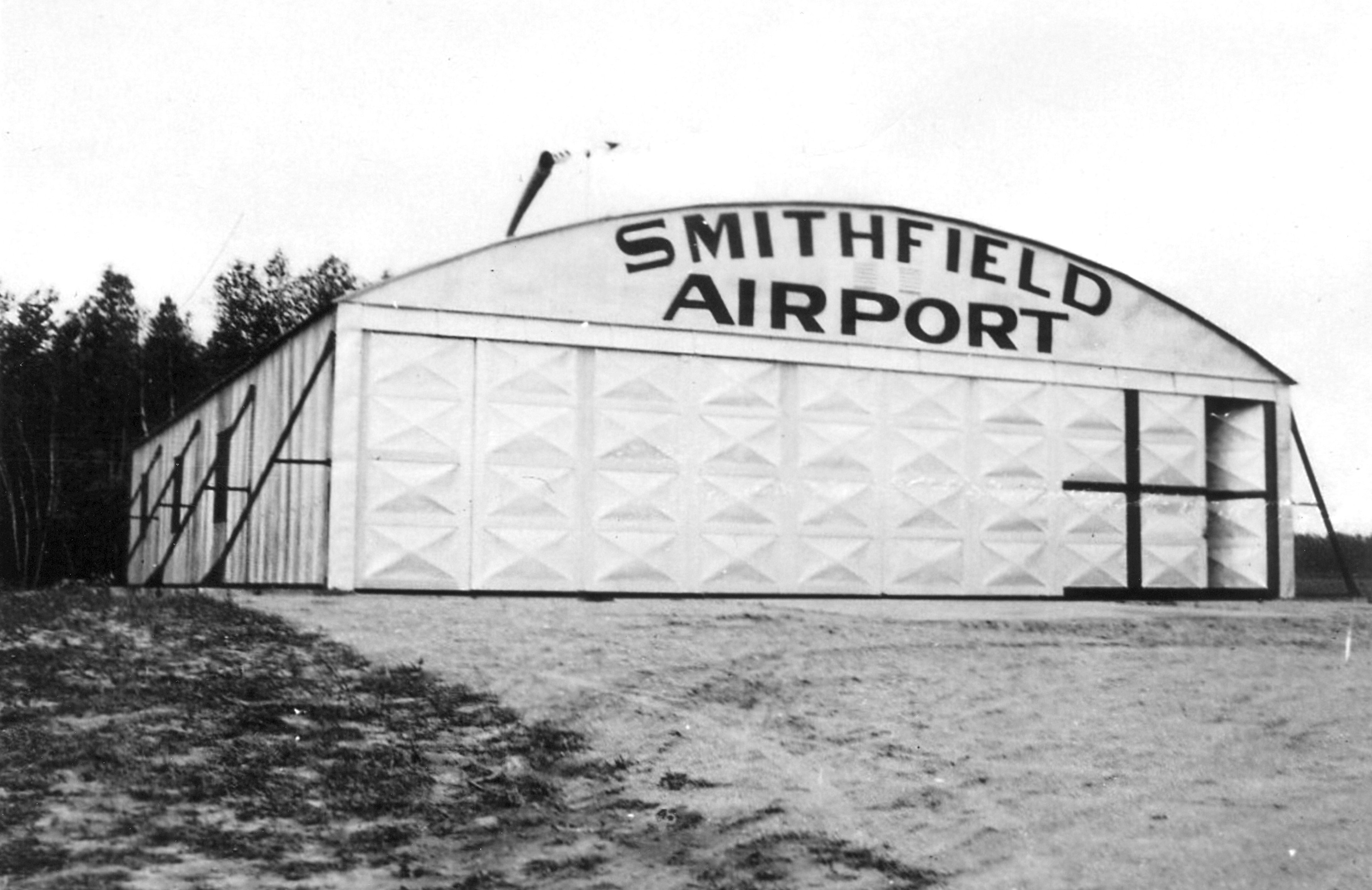
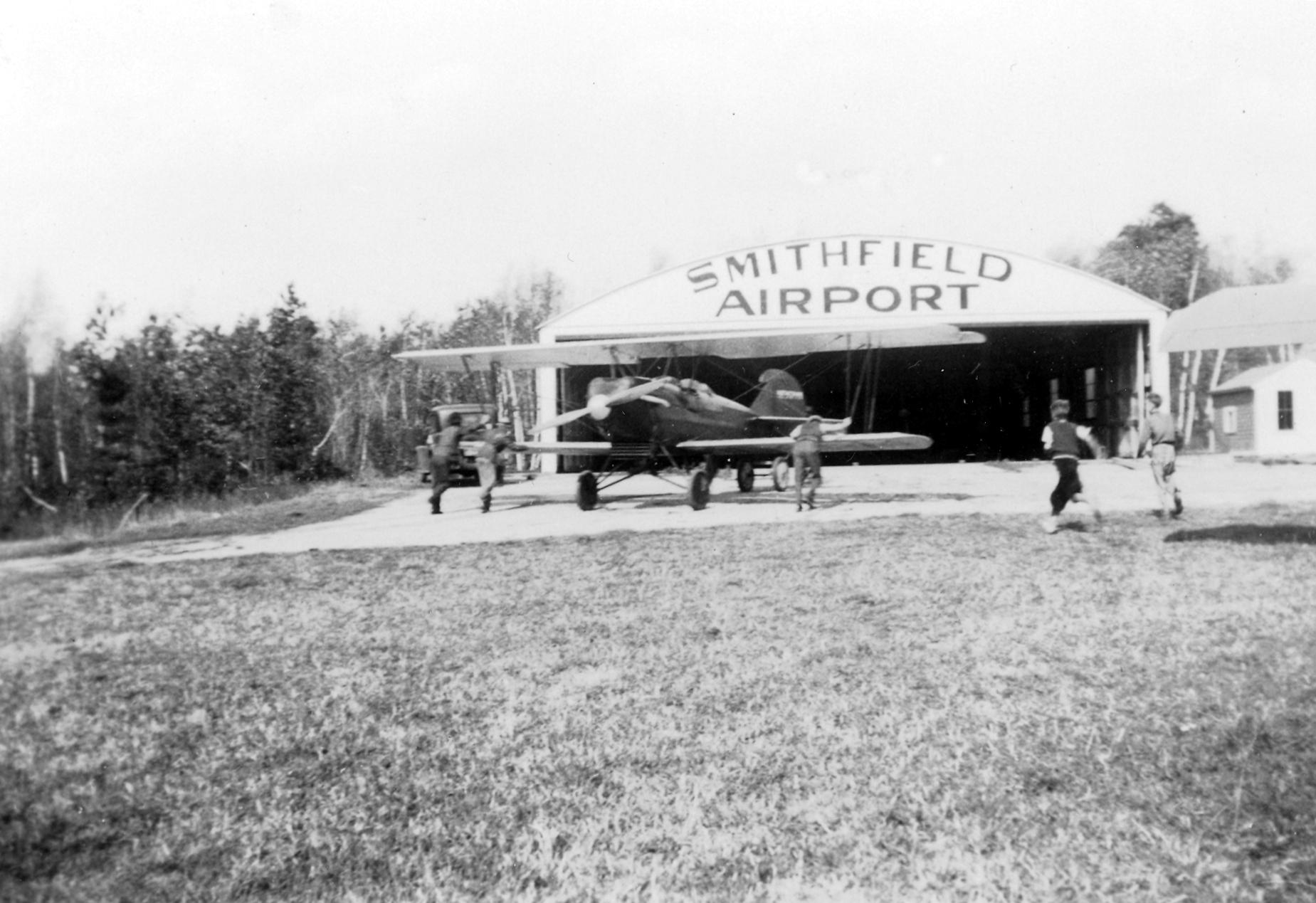

Smithfield Airport Hangar – Unknown Date
Courtesy Louis McGowan
Johnston, R.I. Historical Society
On May 19, 1938, during National Airmail Week, several planes carried airmail away from the Smithfield Airport. Mrs. Ellen Russell, the postmaster for Georgiaville, cancelled envelopes with a special stamp.
On February 1, 1941, it was announced that the Smithfield Airport might be developed into a secondary civil airport comparable to Hillsgrove Airport in Warwick. The primary reason was to establish a major airport that could service northern Rhode Island and nearby Massachusetts. There was also the prospect of getting involved in the war raging overseas in Europe. If that happened, Hillsgrove was to become a military airfield.
History has shown that the United states did enter the war (World War II) on December 7, 1941.
Plans for developing the Smithfield Airport moved swiftly at first, with proposals to relocate the hangar and build longer runways. However, these proposals never materialized.
In July of 1941 the Nelson Aircraft School was established at the Smithfield Airport.
On October 5, 1941, what was described as a “spectacular air meet” was performed at the airport. Over 15,000 people attended and vehicle traffic overwhelmed the back roads and two-lane Douglas Pike leading to the airport. Local and state police had a difficult time dealing with the blocked roadways and stand-still traffic.
One event at the air meet included a parachute jump from 3,000 feet. Arthur Daigle, the parachutist from Norwood, Massachusetts, was carried off by the wind and landed in a wooded area outside the airport. He wasn’t injured.
The United States entered WWII on December 7, 1941. By April of 1942, the U. S. Army had taken over Hillsgrove Airport for use as an army air field, and all civilian aircraft were ordered removed. Some of those aircraft ended up in Smithfield where they were staked to the ground as there wasn’t enough room in the airport hangar. It was reported that thirty planes were intitially brought to Smithfield, and a few more followed over the next few days.
By August of 1942, the U. S. Army banned all civilian aircraft from flying in the “Eastern Seacoast Zone” which included all of Rhode Island. Plane owners were given short notice of the ban, and some opted to take their aircraft further inland to western Massachusetts where the ban did not apply. Those who failed to do so were forced to keep their airplanes in Smithfield for the duration of the ban, which wouldn’t be lifted until August of 1945.
In October of 1945, Smithfield’s first post-war air show was scheduled to be held at the airport, but had to be postponed twice due to bad weather. The event was finally held at the end of November.

The Attleboro Sun
July 2, 1949