Pothier/Buttonwoods Field – Warwick, Rhode Island

Potheir/Buttonwoods Field, Warwick, Rhode Island

     Pother Field, later known as Buttonwoods Airport, was located in the Buttonwoods section of Warwick, Rhode Island, on the shore of Greenwich Bay.  Exactly when the airfield began operations is unclear, but based on newspaper articles it is known to have been in operation as early as the spring of 1927.  

     The airport was owned by Arman C. Pothier, nephew of former Rhode Island Governor, Aram J. Pothier; born 1854; died February 4, 1928.     

     In June of 1927 it was reported in the Woonsocket Call newspaper that Arman had offered his flying field for use by the City of Providence, free of charge, for a period of five years.  At the time, Providence officials were actively seeking a location for an airfield, and with Pothier Field being on the water, it could also accommodate seaplanes.    

     Source: Woonsocket Call, “Woonsocket Flyer Offers Providence Use Of His Field”, June 2, 1927.

     On July 26, 1928, the airport witnessed it’s first plane crash.  For more information, click here.  

     On November 27, 1928, the airport witnessed another plane crash.  For details, click here.  

     On May 25, 1930, a plane made a one-wheeled landing.  For more information, click here.  

     By 1932 the airport had two runways.  The east-west runway was 1,834 feet long, and the north-south runway was 1,856 feet long.  

     The following information is from a publication distributed by the Unites States Department of Commerce – Bureau of Air Commerce, titled, “Descriptions of Airports and Landing Fields in the Unites States”, Airway Bulletin #2, dated September 1, 1934.  

“Warwick – Buttonwoods Field, auxiliary.  Located on Greenwich Bay in Buttonwoods section of the city.  Altitude, 10 feet.  Open for seaplanes.  No service facilities.”


Warwick, R. I. – May 25, 1930

Warwick, Rhode Island – May 25, 1930

     On May 25, 1930, Charles Weaver, operator of the Buttonwoods Flying Service Inc. at Pothier Field in Warwick, and Charles Loring, his chief pilot, arrived at Trumbull Field in New London, Connecticut, to demonstrate a new aircraft to a group of army aviators as a perspective training ship.   A large number of servicemen were at the airport in anticipation of upcoming “war games” over Long Island Sound.  

     When their work was completed, they took off from Trumbull Field to return to Pothier Field.  As they became airborne one of the landing gear wheels of their aircraft fell away and neither man noticed, but the sight was witnessed by several army aviators. 

     Thinking quickly, Lieutenant F. G. Anderson climbed into his own aircraft and took off in pursuit to warn the men of the danger.  Another pilot, Lieutenant John J. Gerhart and his observer found some white paint and quickly painted the warning, “Your landing gear is gone” on the side of their plane.  They too took off in pursuit.  

     Lt. Anderson caught up with the Rhode Island men as they were passing over Westerly, but they didn’t understand what he was trying to warn them about.  A short time later Lt. Gerhart’s plane caught up and when the men read the warning on the side of his plane they understood.  

     Loring then turned over control of the plane to Weaver and then climbed out of the cockpit and onto the wing to get a clear view of the situation.  

     Meanwhile, mechanics at Pothier Field had received word by telephone of the situation and made preparations for a crash landing. 

     The disabled plane made a successful one-wheel landing with minimal damage and no injuries.  The army fliers were credited with preventing what would have been a serious accident.   

     Source:

     Woonsocket Call, “Airmen Land Safely With One Wheel Missing”, May 26, 1930.

Warwick, R. I. – July 26, 1928

Warwick, Rhode Island – July 26, 1928

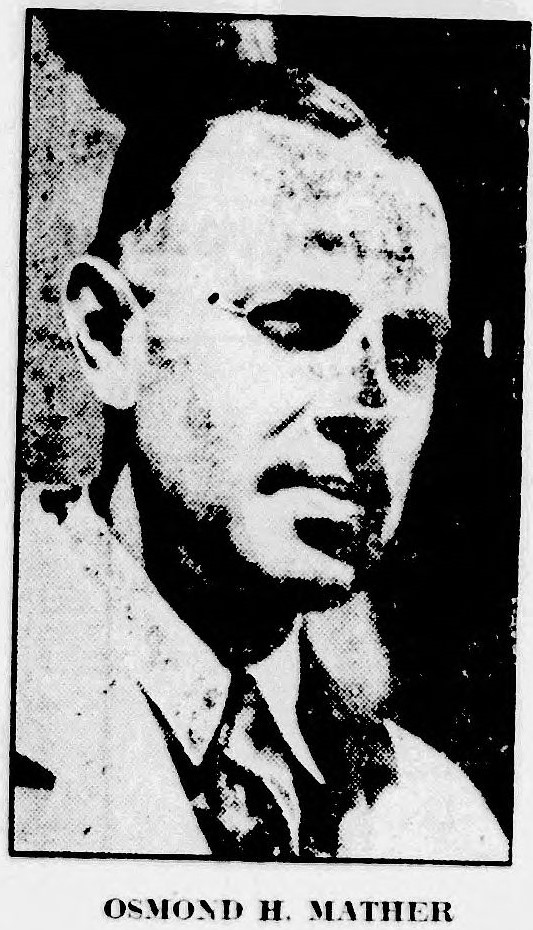
    On the evening of July 26, 1928, well known Connecticut aviator, Osmond H. Mather, took off from the Buttonwoods Airfield in Warwick, Rhode Island, in a small black and orange mono-coupe airplane.  With him as a passenger was Clifton H. Thompson, of Foxboro, Massachusetts.  The purpose of the flight was to demonstrate to Mr. Thompson the plane’s capabilities as Thompson was considering buying the plane for use at the newly opened Providence Airport in Seekonk, Massachusetts.  

     About one hundred people on the ground watched as the aircraft went through a series of maneuvers, among them was Thompson’s wife and daughter.  At one point while the aircraft was only 100 feet from the ground, it suddenly went into a dive before it crashed and exploded about 200 yards from the edge of the flying field.  Both occupants were killed instantly. 

     Osmond Mather was a well known pilot in the New England area,   and a World War I veteran who’d served in the Air Corps.   About five months before his death, he flew over the home of Connecticut’s Governor, John Trumbull, and dropped a box containing a miniature reproduction of Charles Lindbergh’s “Spirit of St. Louis”.  The gif was in honor of the Governor’s 55th birthday. 

https://www.findagrave.com/memorial/132372604/osmond-m-mather

     Clifton Thompson was also a World War I veteran having served in the Air Corps.  https://www.findagrave.com/memorial/175077080/clifton-badlam-thompson

Sources:

     New Britain Herald, “Osmond H. Mather Dies In Airplane”, July 27, 1928, p.4.

     New Britain Herald, “Gift From Sky Dropped On Gov. Trumbull’s Lawn”, March 5, 1928, p.1. 


Bourdon Aircraft Company

Bourdon Aircraft Company

Warwick, Rhode Island


    1920s-plane-in-clouds The Bourdon Aircraft Company was incorporated in Rhode Island on February 6, 1928, by Allan P. Bourdon. The company initially began production in the former Gallaudet Aircraft factory in the Chepiwanoxet part of Warwick, but moved shortly afterwards to a former textile mill in the Hillsgrove portion of the city.

     Bourdon Aircraft was known for production of the two-passenger “Kittyhawk” bi-plane, said to “Fly like a hawk, and land like a kitten.” Powered by a 7-cylinder Siemans-Halske motor, it was 22 ft. 6 in. long, and had a 28 ft. wingspan. The aircraft was designed by Bourdon’s engineer, Franklin Kurt.

     The name “Kittyhawk” was bestowed on the aircraft because of the Wright Brothers flight at Kittyhawk, North Carolina, in 1903.

     The company finished it first airplane in May of 1928.

     On May 18, Allan Bourdon flew his Kittyhawk from Buttonwoods Airport in Warwick to Boston for its first long distance flight, which took a total of 32 minutes to complete.  After being inspected by Assistant Secretary MacCracken of the U.S. Department of Commerce Aviation Division, the plane returned to Buttonwoods.

     By January of 1929, the Bourdon Aircraft Company had produced eight Kittyhawk airplanes.  It was reported that the company intended to begin producing one airplane a week beginning in March of that year, some of which would be equipped with pontoons for water take-offs and landings. Unfortunately the production goal did not materialize, and a total of only thirteen Kittyhawks were built in Rhode Island.    

     On April 3, 1929, it was announced that the U. S. Department of Commerce had granted the Bourdon Aircraft Company certificate number 134, signifying that their aircraft had met the standards of the D.O.C. regarding their ability to perform well in many kinds of flying conditions.  

     On October 16, 1929, it was announced that the Bourdon Aircraft Company would be merging with the Viking Flying Boat Company of New Haven, Connecticut, and by the end of the month production would be moved to New Haven.  The announcement came just thirteen days before the great stock market crash of 1929.

     In 1931, the Viking Flying Boat Company was acquired by Stearman-Varney Inc. which continued aircraft production in New Haven until 1936.

Sources:

The Providence Journal, “Bourdon Biplane Flies To Boston”, May 19, 1928

The Providence Journal, “Builder Of Planes Hits R. I. Apathy”, January 22, 1929

The Providence Journal, “Kitty Hawk Airplane Wins Official Sanction”, April 4, 1929

The Providence Journal, “Bourdon Aircraft Company Merged; To Leave State”, October 17, 1929.

(Magazine) Aeronautical Industry – Vol. 8, page 58, “Air Transportation”, “Bourdon Kittyhawk Designed For Radial Engine, Standardizes On Siemens Yankee”, by J. E. Bullard, August 3, 1929

(Book) American Flying Boats And Amphibious Aircraft; An Illustrated History, By E. R. Johnson, McFarland & Co. Inc. Publishers, Copyright 2009

Return to Top ▲Return to Top ▲