Bangor Air Base – Bangor, Maine – December 19, 1941
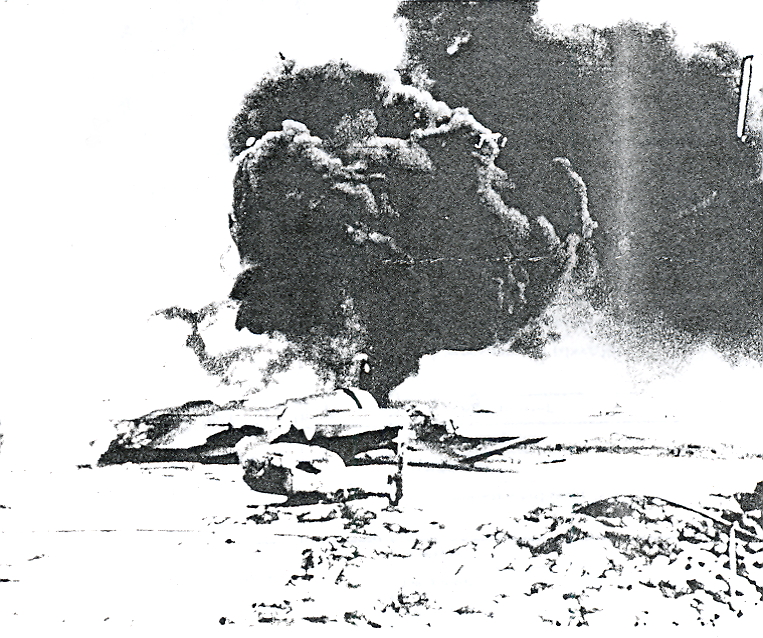
B-17A Ser. No. 37-369
U.S. Air Force Photo
At 10:30 a.m., on December 19, 1941, a Boeing B-17A (Y1B-17A) (Ser. No. 37-369) crashed and burned on take off from Bangor Air Base. All nine crewmen aboard escaped, however three were seriously injured.
Crew members were identified in the aircraft accident investigation report as:
(Pilot) Major Carl T. Goldenberg
(Co-pilot) 2nd Lt. D. W. Johnson
2nd Lt. D. S. Winslow
(Photographer) (Rank Unknown) J. C. Robinson
(Engineer) T/Sgt. John W. Freeman
(Radio Operator) S/Sgt. T. L. Young
S/Sgt. L. H. Waltman
Cpl. L. P. Lawfer
Pfc. P. S. Keever
Only first initials were used to identify the crew in the accident investigation report with the exception of the pilot and engineer.
This New England military aircraft accident is some-what historically significant due to the fact that the aircraft was one-of-a-kind.
The fuel system for this aircraft had been changed (Upgraded) the previous day by a Master Sergeant who’d been sent to Bangor specifically to do the job. The reason for such an unusual measure was because this B-17 was a testing prototype fitted with superchargers on the engines, and the Army Air Corps, had much time, money, and resources devoted to this project.
At the time of this crash, the Air Corps was in the process of developing a modern four-engine, high-altitude bomber. This B-17 (37-369) was the fourteenth produced by Boeing, but the only one designated an “A” variant, and the first to be equipped with turbo-superchargers, which were considered necessary for the aircraft to operate at higher altitudes with greater speed.
The accident investigation committee tasked with finding the cause of the accident made the following two conclusions which are transcribed here.
1) “A change of the fuel system for this aircraft had been completed the day previous to the accident by M/Sgt. ———– sent to Bangor Air Base by rail from Wright Field, Dayton, Ohio, specifically for the purpose of making the change from hydro power to a direct drive fuel pump. A thorough test of the new installation was made previous to the take off and no indication of malfunctioning was revealed. Also, upon examination of the number four engine fuel pump after recovery, the same was found true. The fuel pump drive on all other engines was melted beyond recovery. It is the opinion of the committee that in no way was the fuel system change a contributing factor to the accident”
2) “It is the opinion of the committee that the pilot reduced the power on the right hand side to overcome the yaw to the left, and that the number three and number four engines failed upon reapplication of the power to those engines. It is believed that the failure was only momentary due to choking, but sufficient to cause a violent yaw to the right; also that this engine failure was sufficient to make it impossible for the pilot to pull up the right wing.”
Sources:
U.S. Army Air Corps Technical Report Of Aircraft Accident #42-12-19-1
Update: July 28, 2026
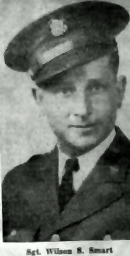
Wilson S. Smart
When the plane came to rest it caught fire, but the main fuel tanks hadn’t exploded, but there was every expectation that they would. Despite the danger, fourteen men ran to the blazing wreck to assist the crew. Two of those men were Private Wilson S. Smart of Tebbetts, Missouri, and Private V. Keahey, of Pickson, Arkansas. Both men observed the pilot, Major Carl Goldenberg, trapped in the burning cockpit attempting to escape through the jammed escape hatch above his head. At great danger to themselves, Smart and Keahey climbed atop the plane and manadged to tear the hatch open and free the pilot.
For their actions, Smart, Keahey, and the other men involed in the rescue were awarded the Soldier’s Medal for Heroism. (The names of the other men are unknown as of this writing.)
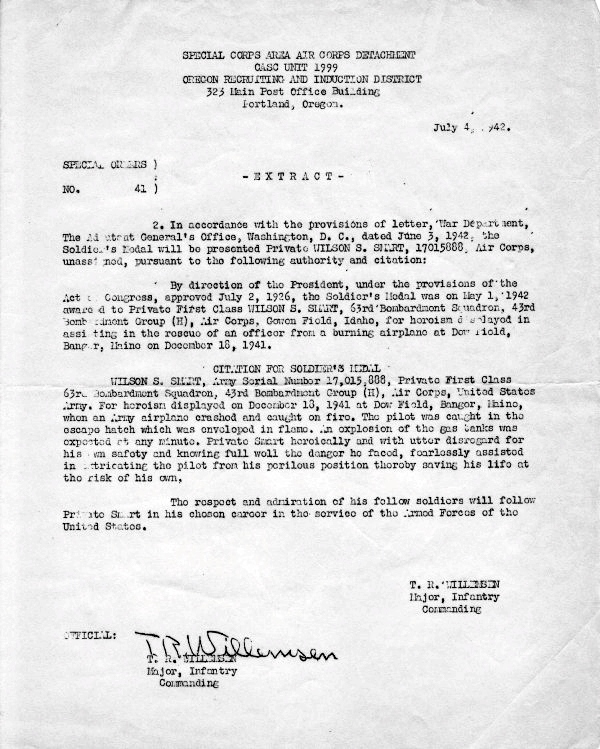
Click on image to enlarge.
Private Smart was promoted to sergeant and later became an officer and a pilot, and then an instructor at Douglas Army Airfield in Bizbee, Arizona. He retired a Lieutenant Colonel. https://www.findagrave.com/memorial/64004246/wilson-sanford-smart
Major Goldenberg survived his injuries and went on to serve in World War II, Korea, and Vietnam, retiring as a Colonel. https://www.findagrave.com/memorial/705515/carl-theodore-goldenberg
Sources:
The following articles are from the Jefferson City News Tribune and the Fulton Daily Sun Gazette.
“Callaway Co. Soldier Cited For Heroism – Private Wilson Smart One Of 14 Honored By War Department”, unknown date.
“Missourian Decorated For Saving Plane Pilot”, unknown date.
“Medal Given To Sergeant”, unknown date.
“Hero Aviation Cadet Given Medal At Victory Center”, unknown date.
“Tebbets Soldier Back From Azores”, unknown date.
Articles provided by Dean S. Smart.
